History of the Niagara Parks Power Station
The history of the Niagara Parks Power Station: the Canadian Niagara Power Company, the 1901 dig, the 1905 generators, a century of power, the 2006 closure and the restoration you visit (Oct 2026).
The Niagara Parks Power Station was built as the Canadian Niagara Power Company’s generating station, the first major power plant on the Canadian side of the Niagara River: work began on 23 May 1901, its first generator turned on 27 July 1905, and it made power for a hundred years until it was decommissioned in 2006. Niagara Parks then took over the building, restored it, and opened it to visitors in 2021, with The Tunnel following on 1 July 2022.

The company and the dig
The Canadian Niagara Power Company was created in 1892 by William Birch Rankine, and in 1927 the station was renamed the Rankine Generating Station after him. Construction began on 23 May 1901. The wheelpit, the tailrace tunnel, a cofferdam to hold back the river and the forebay were all dug at the same time, with rudimentary dynamite, pickaxes, shovels, horses and lanterns. The cofferdam stayed in place for about two years, and the forebay was dug to 14 feet. The tunnel was begun from a vertical shaft halfway along, with crews digging towards the plant and the river at once.
The building’s design was inspired by the Adams Generating Station, and the limestone inside came from the Queenston Quarry.
How the water made power
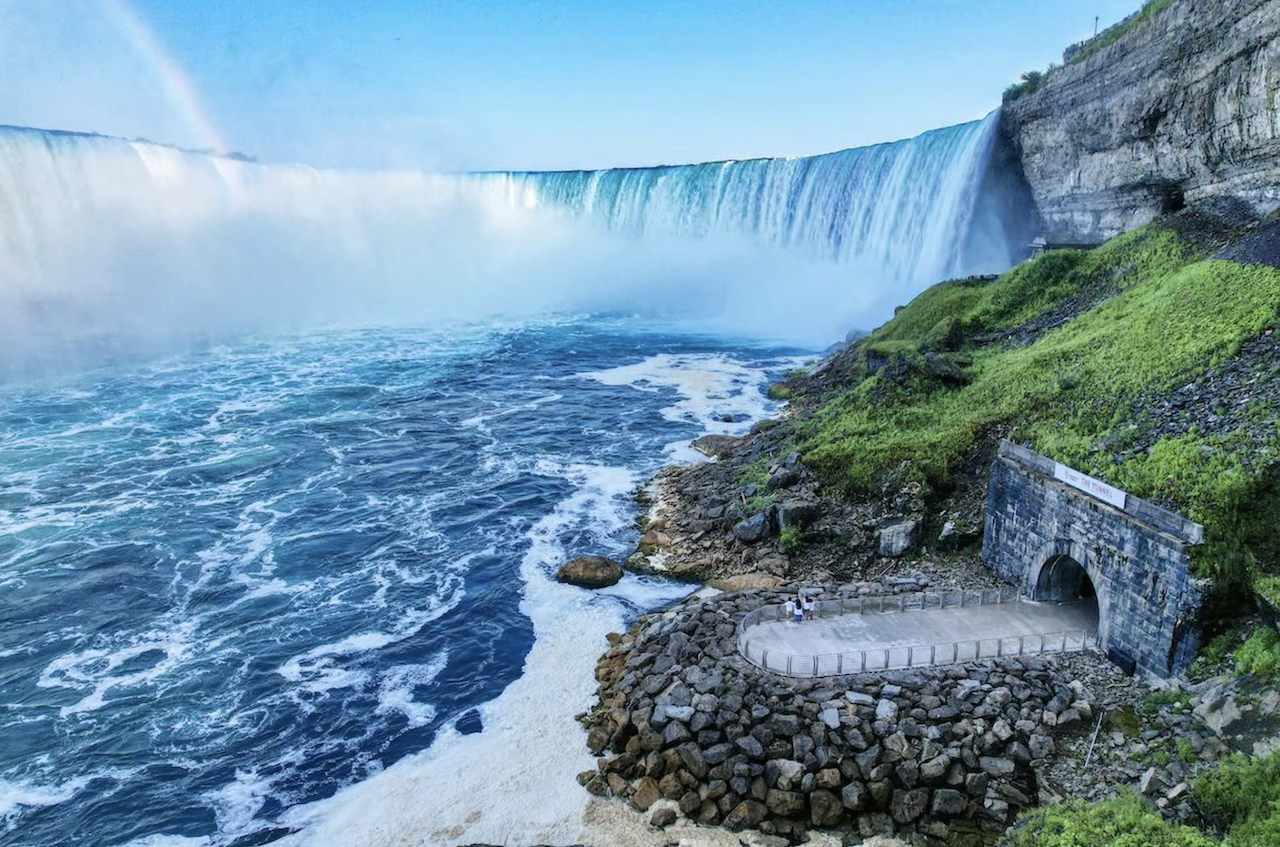
River water entered the forebay upstream of the station, where ice racks kept debris out of the penstocks, the great pipes that dropped it into the wheelpit. At the bottom it turned the turbines, which drove the generators in the hall above, and the spent water ran out through the tailrace tunnel to rejoin the river at the base of the falls. That tunnel is the one you walk through, and the platform at its end is the old exit portal.

From five generators to eleven
The plant was ready to run by the end of 1904, but its generators did not start until 27 July 1905. Generator 1 produced 10,000 horsepower, and the first five generators were imported from Switzerland. At opening the building was 296 feet (90 m) long. In 1913 it was extended to 600 feet (183 m), five more generators were added by 1917, and the eleventh, of 12,000 horsepower, arrived in 1924, bringing the plant to 121,000 horsepower. Its exciters weighed 45,000 pounds and spun at 600 revolutions a minute.
The eleven generators are still on the floor, painted blue, the colour they were when the station closed in 2006. Niagara Parks calls it the only fully intact, decommissioned hydroelectric power plant of its era in the world.
The restoration
When Niagara Parks assessed the building in 2017, river water was still getting into the plant, and a concrete barrier was placed in front of the penstocks. The first phase of construction ran from 2018 to 2021, with more than 400 people from about 75 contractors working in the building. The restored station opened in 2021, with the Currents show, and won the Lieutenant Governor’s Heritage Award for Excellence in Conservation that year. The second phase, The Tunnel and its platform at the river, opened on 1 July 2022.
The neighbours
The station was one of several built by the falls in the same years. Niagara Parks’ plaque at the Ontario Power Company’s station, down in the gorge below the falls, says that station was commissioned in 1905 and was the first major alternating-current generator on the Canadian side. The Toronto Power Generating Station stands a short way upriver along the parkway, across from the Floral Showhouse; it stopped producing electricity in 1974, and Niagara Parks has leased it for a private redevelopment with a hotel, public viewing areas and dining, its grand opening targeted for 2028. You see it from outside.
Seeing the history in the hall
The self-guided visit covers the story with exhibits, a scale model of the water’s path and a life-size penstock section, and the bilingual audio tour comes with admission. The 45-minute guided Premium Tour adds the restored control room and ends with a Tesla coil demonstration. If you would rather have the whole hydro story told as a walk, the Skylon Tower and Power Station guided walk (Walks Canada) starts with Edison, Tesla and the War of the Currents at the Skylon Tower and finishes in the station and The Tunnel. Most visitors do it on their own with the Power Station and Tunnel ticket (Niagara Parks); Niagara tunnel tickets compares the prices.
The company, Rankine, the renaming, construction dates and methods, the cofferdam, forebay, tunnel dig, design inspiration, limestone, the water’s path, the generators, the building’s lengths, horsepower, exciters, colour, closure, restoration, award and opening dates are from niagaraparks.com (its history of building the power station, the station construction page, the generator records, the William Birch Rankine story page, the 2020/21 annual report, the 2022 news release on The Tunnel and its news release on the Tesla exhibit); the Ontario Power plaque from its heritage plaques page; the Toronto Power Generating Station from Niagara Parks’ 2026-27 tour study guide and its 2024/25 annual report. All read in October 2026. The stations’ positions and distances are measured on the map. Niagara Parks’ Rankine page dates the official opening to January 1905; we give the date the generators first ran.
Can't Make These Dates?
Browse More Available Options
Find a tour that fits your schedule. Dates and cancellation terms are on each listing.
See the Hall for Yourself
Niagara Parks' own admission: the generator hall with its eleven generators, the glass elevator down the wheelpit and the 2,200 ft tailrace tunnel to the river. Free cancellation up to 24 hours before, as listed in October 2026.
See the Ticket